



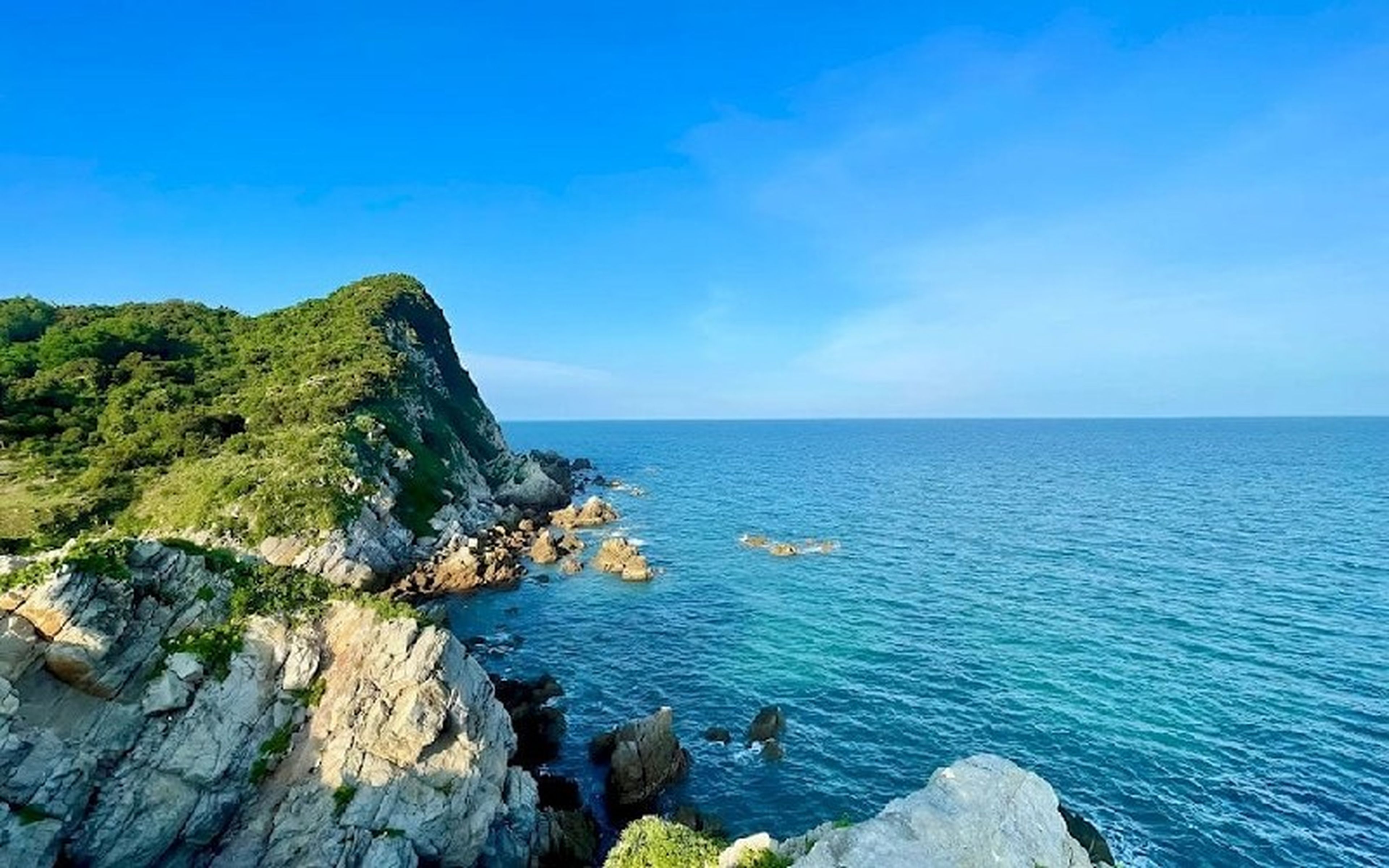



1 Where is Bai Rua, Quan Lan, and what makes it special?
Bai Rua is located at the northernmost tip of Quan Lan Island, in Van Don District, Quang Ninh Province. The beach is around 5 to 7km from the island center, and there is no paved road leading all the way there. The final stretch requires a 15- to 20-minute walk or motorbike ride along a trail beneath the forest canopy.
What sets Bai Rua, Quan Lan, apart from the island's other beaches is not just its secluded location. The beach stretches for around 800m, with fine white sand interspersed with moss-covered pebbles, creating scenery unlike any other beach I have ever visited. The shallow water is so clear that you can see the seabed even when standing quite far from shore. Behind the beach, a lush wall of primary forest rises like a natural barrier.

Bai Rua, Quan Lan, has fine white sand interspersed with moss-covered pebbles. Illustrative image: VinWonders
2 Bai Rua, Quan Lan review: Firsthand experiences
You can't visit the beach every day, but I have never been disappointed on the occasions I've made it there. There are a few things I want to be honest about so visitors know what to expect.
2.1 Scenery and seawater
I visited Bai Rua, Quan Lan, early in the morning, at around 7h. The sea was calm, the light was soft, and sea mist lightly veiled the horizon. As I emerged from the forest onto the beach, the first thing I saw was black rocks covered in green moss, scattered along the water's edge.
It wasn't an ordinary rocky beach or an ordinary sandy beach, but something in between, as if someone had carefully arranged it. The water was so clear that I could see every pebble and the small patches of seaweed beneath my feet.
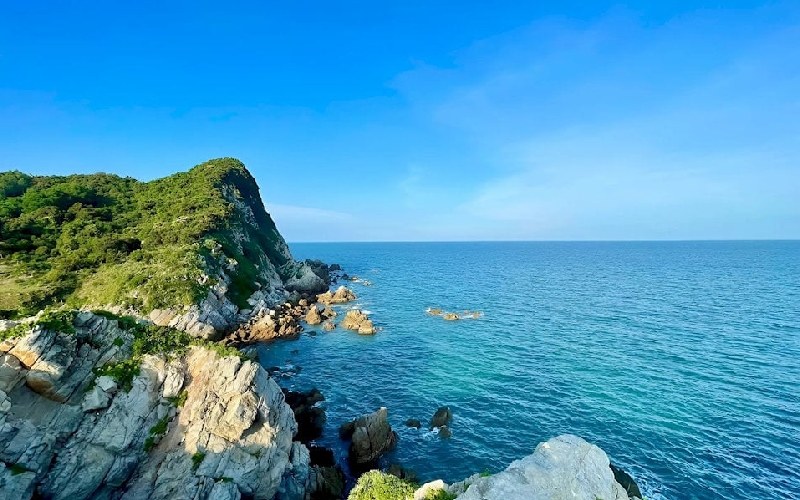
The peaceful morning scenery features clear blue water, with small patches of seaweed visible beneath the surface. Illustrative image: Vietnam Airlines
2.2 How quiet is it in practice?
Bai Rua, Quan Lan, is still quiet on weekends, especially if you arrive before 9h or after 16h. There are no facilities, food stalls, or rental chairs. That's one of the things I like about it: the beach retains its rustic charm and has not been urbanized. However, remember to bring these essentials with you so you can enjoy a worry-free day here.

Bai Rua remains unspoiled because it has not yet been heavily developed for tourism. Illustrative image: Gody
2.3 Sunset and sunrise
Bai Rua faces north, so it is not an ideal spot for watching a classic sunset. However, the late-afternoon light turning the sea and mossy rocks golden is something I never tire of photographing. Sunrise here is more beautiful than sunset, especially when the sun has just risen above the horizon and its first rays fall on the water.
3 How to get to Bai Rua, Quan Lan
To reach Bai Rua, you first need to get to Quan Lan Island. Here is the route from Hanoi that I usually take.
3.1 From Hanoi to Quan Lan Island
From Hanoi, you can take a bus or limousine to Ao Tien Port in Van Don District. The journey takes around 3 to 3.5 hours. From there, take a high-speed boat to Quan Lan Island; the trip takes around 30 to 40 minutes. Boats run several times a day, and a one-way ticket costs around 80,000 to 120,000 dong.
There are also boat routes to Quan Lan from Ha Long or Cam Pha, though these require a few additional bus rides.

The trip from Hanoi to Quan Lan Island takes around 3 to 3.5 hours. Illustrative image: VinWonders
3.2 From the island center to Bai Rua
After arriving at Quan Lan Port, rent a motorbike near the pier for around 120,000 dong per day. Head north across the island, pass through the fishing village, then continue along the dirt road for about 5 to 7km. From the point where the road ends and vehicles can go no farther, continue on foot for around 15 to 20 minutes along a forest trail to reach the beach.
Note: The dirt road to Bai Rua can be slippery after rain, so take care if you are riding a motorbike.
4 When should you visit Bai Rua?
In my experience, Bai Rua, Quan Lan, is at its most beautiful from April to June. The weather is sunny but not too hot, the water is at its clearest of the year, and the waves are small.
The sea is beautiful in July and August, but strong winds sometimes occur. From September to November, there is more rain and the road in is harder to navigate, so plan accordingly.

April to June is the best time to visit Bai Rua, Quan Lan. Illustrative image: QUANG THANG CAT BA
During the day, the ideal time to visit is in the morning, from 6h to 10h. The light is beautiful, there are fewer people, and it is not yet hot, making it comfortable to sit on the sand and enjoy the atmosphere without worrying about getting sunburned.
5 What should you bring to Bai Rua?
There are no facilities at the beach, so you should prepare almost everything in advance.
- Bring at least 1.5 liters of drinking water per person, snacks for the day, sunscreen, and a towel.
- Wear shoes with good grip or sturdy flip-flops, as some sections of the path are slippery with rocks.
- Bring a bag to carry your trash home. This is one of the few clean beaches that has retained its unspoiled beauty, and I hope it stays that way for a long time.

Remember to bring the essentials to make the most of your trip. Illustrative image: VinWonders
6 FAQ - Frequently asked questions about Bai Rua, Quan Lan
6.1 Where exactly is Bai Rua, Quan Lan?
Bai Rua is located at the northernmost tip of Quan Lan Island, in Van Don District, Quang Ninh Province.
6.2 Is there an entrance fee for Bai Rua?
There is no entrance fee; the beach is open to visitors free of charge. However, you will need to rent a motorbike on the island to get there.
6.3 Is Bai Rua suitable for young children?
It is suitable if children can manage a 20-minute walk through the forest. The water is shallow and the waves are small in summer, making it safe for swimming.
With its unspoiled beauty and fresh island atmosphere, Bai Rua, Quan Lan, is an ideal destination for nature lovers. It is sure to offer beautiful photo opportunities and memorable experiences on your backpacking adventure around Quan Lan.